.png)
How to Plan a Bathroom Renovation (Without Losing Your Mind or Your Budget)

There’s a particular moment that happens in almost every bathroom renovation. It’s not the first tile sample.It’s not choosing the brassware. It’s not even the excitement of seeing it all come together. It’s the moment you realise this is far more complex than I thought.
Bathrooms are deceptive. They’re small spaces, but they carry an enormous amount of technical weight. Plumbing, electrics, ventilation, waterproofing, heating, lighting all working within a footprint that rarely forgives mistakes.
And yet, when done well, a bathroom can feel like a sanctuary. A place where the day begins gently and ends quietly. So, the goal isn’t just to “get it done.” It’s to plan it properly so it feels effortless when you finally step into it.
Here’s our guide on how to approach your next bathroom makeover.

1. Start With How You Want It to Feel
Before layouts, before Pinterest, before budgets start here.
Do you want:
Calm and spa-like?
Sleek and architectural?
Warm and softly layered?
A space filled with personality?
This is the foundation. Because every decision that follows, from tile size to lighting temperature should reinforce that feeling.
A helpful way to approach this is to pull together 3–4 reference images that feel aligned and then look for the common thread, whether that’s tone, contrast, or materiality. That becomes your anchor point for the scheme.
Without this clarity, bathrooms often become a collection of nice elements that don’t quite settle together.
2. Get the Layout Right (Everything Else Follows)

A beautiful bathroom with a compromised layout will never feel quite right.
Think carefully about:
Sightlines when you walk in
Spacing around key elements (vanity, shower, bath)
Door swings and awkward corners
Storage, not as an afterthought, but as part of the design
As a guide, if something feels tight on plan, it will feel tighter in reality, so allowing comfortable clearance around each element is key.
Sometimes fitting everything into a smaller space is technically possible, but it won’t always feel enjoyable to use. I often encourage clients to think about their bathrooms across their home as a whole. For example, if you already have a bath elsewhere in the house, it may be more valuable to prioritise a generous shower and double vanity in an ensuite.
Make the space work for your lifestyle, rather than feeling it needs to follow a blueprint.
3. Choose Materials That Will Work in Real Life
Bathrooms are high-use, high-moisture spaces and this is often where beautiful ideas start to unravel if they haven’t been thought through properly.
When selecting materials, it’s worth considering how they’ll actually perform day to day. For example:
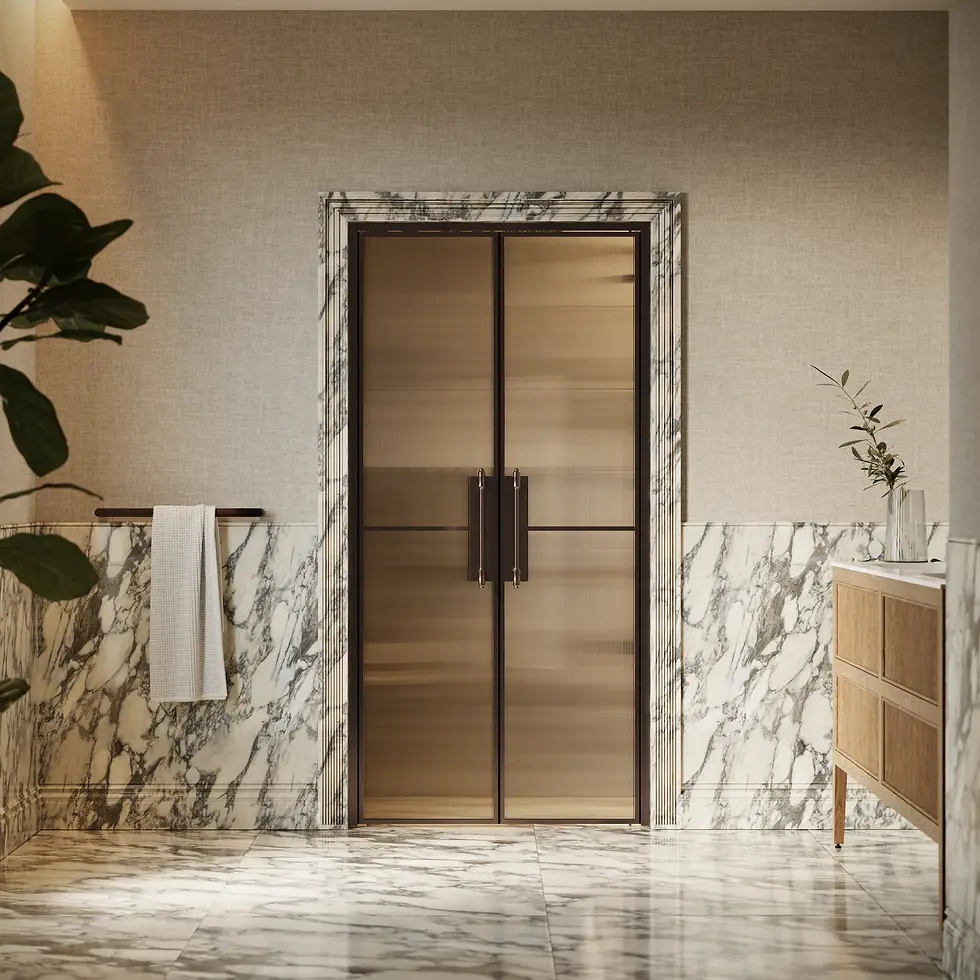
Highly polished tiles can look stunning but may not be practical on floors where slip resistance matters
Very pale grout can feel fresh initially, but will require more upkeep to maintain• Natural stone requires sealing and ongoing care, which isn’t always suited to busy households. In these cases, porcelain tiles that mimic stone (such as limestone or marble) can offer a more practical, low-maintenance alternative.
Some brass finishes will patina over time which can be beautiful, but should be an intentional choice
Where possible, it’s worth ordering samples and viewing them in situ particularly for tiles and stone as lighting and surround
ing finishes can significantly affect how materials read in a space.
It’s less about compromising on aesthetics, and more about making informed decisions early on so the space continues to feel as good in a year’s time as it does on day one.
4. Lighting Is Everything (And Usually Underrated)

One overhead light will never do the job.
A well-considered bathroom layers lighting:
Soft ambient lighting for overall atmosphere
Task lighting at the mirror (this is non-negotiable)
Accent lighting to create warmth and depth
Ideally, mirror lighting should sit at eye level (or slightly above) to avoid casting shadows.
And importantly lighting should feel flattering. Not clinical or harsh. This is often the difference between a bathroom that feels functional and one that feels genuinely considered.
5. Plan the Sequence, Not Just the Design
Alongside the design itself, it’s worth thinking about how the project will unfold in practice.
Bathroom renovations involve a number of stages from initial strip out, to plumbing and electrics, through to tiling and final installation and while you don’t need to manage each step in detail, having a general understanding of the order helps everything run more smoothly.
It’s also worth ordering key items early (such as tiles, sanitaryware and brassware), as lead times can often be longer than expected and may impact the overall timeline.
With the right planning in place, the process tends to feel far more straightforward and avoids that sense of things happening out of sync.
The End Result
A bathroom doesn’t need to be overly complicated to feel considered.
When the key decisions are resolved early (layout, materials and lighting) everything else tends to fall into place more naturally.
The result is a space that not only looks good but works well for everyday life.


_edited.png)
Comments